Wolke's Guide to Japanese
Published on: 9/28/2025
•Author: Wolke
Learning Japanese: A Practical Guide
This guide shares the methods that worked for me during my Japanese learning journey. Use it as a reference point to find what works best for you.
Updated regularly based on new insights and feedback
Understanding Japanese Writing Systems
Japanese uses three distinct writing systems that work together, unlike languages that rely solely on alphabetic scripts:
- Hiragana: A syllabic script for native Japanese words and grammatical particles
- Katakana: A syllabic script for foreign loanwords, onomatopoeia, and stylistic emphasis
- Kanji: Logographic characters representing concepts, borrowed and adapted from Chinese
Hiragana: Your Foundation
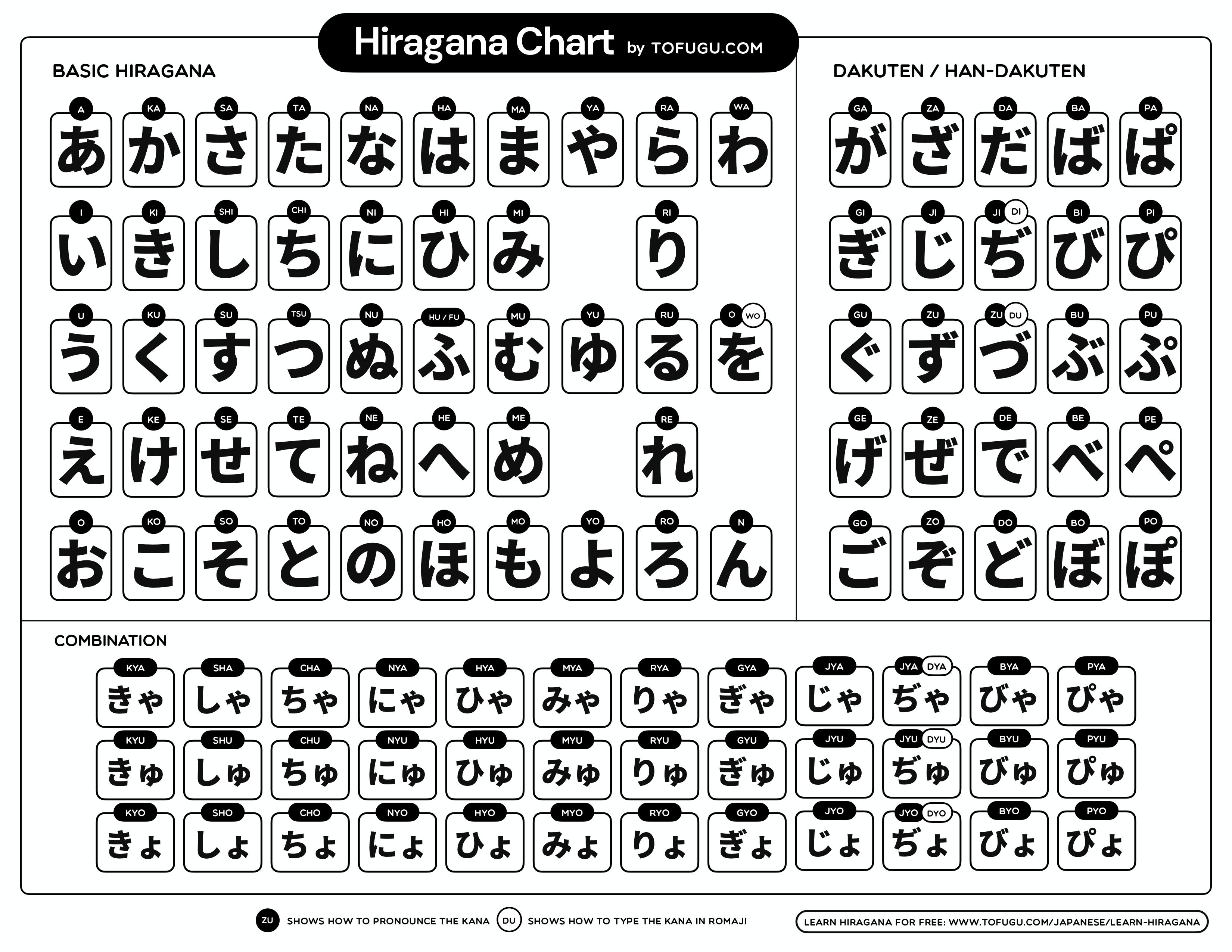
Image from Tofugu
Hiragana forms the backbone of Japanese writing. Master this first—everything else builds on this foundation. I recommend dedicating your initial weeks to hiragana mastery before moving forward.
Key modifications to understand:
Dakuten and Han-Dakuten
These marks modify base sounds:
は(ha) becomesば(ba) with dakuten orぱ(pa) with han-dakuten- Applied to k, s, t, and h sounds (only h sounds use han-dakuten)
Important exceptions:
- つ (tsu) → づ (du)
- ち (chi) → ぢ (di)
- し (shi) → じ (ji)
Combination Characters
Small や, ゆ, よ combine with other characters to create new sounds:
- に + や = にゃ (nya)
My learning approach: Pure memorization through repetition. Both hiragana and katakana contain manageable character sets. I used Kana Pro for daily practice until recognition became automatic.
Katakana: Foreign Words and Style
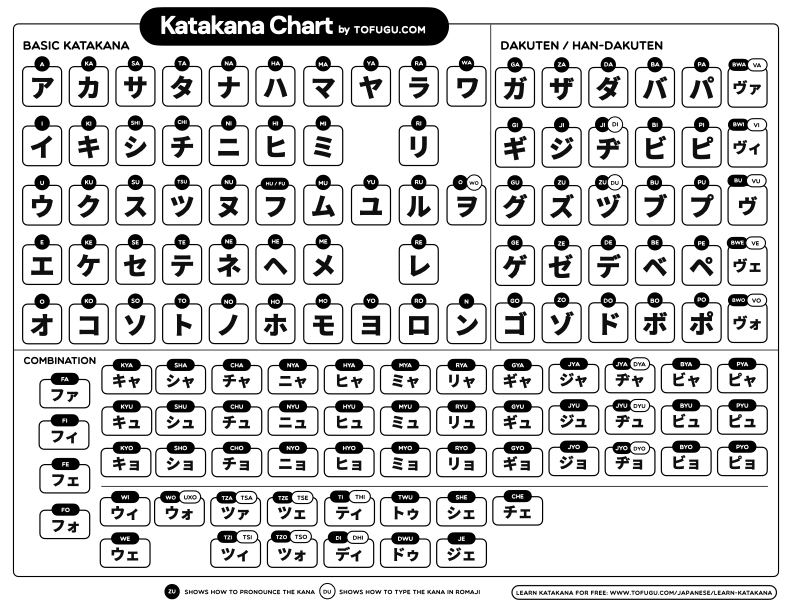
Image from Tofugu
Katakana follows the same phonetic principles as hiragana but serves different purposes. You’ll encounter it constantly in modern Japanese, especially for:
- English loanwords
- Technical terminology
- Stylistic emphasis
Extended combinations: Katakana includes additional sound combinations absent in hiragana (fa, fe, wi, we, che, she, etc.) to accommodate foreign pronunciations.
Examples:
- Visual Kei → ヴィジュアル系 (vijuaru-kei)
- ChatGPT → チャットジーピーティー (chatto-ji-pi-ti)
Learning approach: Use the same memorization strategy as hiragana. Kana Pro works perfectly for katakana practice as well—drill until recognition becomes automatic.
Kanji: The Complex Foundation
Kanji represent the most challenging aspect of Japanese literacy, but they’re essential for meaningful communication. Japanese has limited syllable combinations, making kanji crucial for distinguishing meaning.
The reading challenge: Most kanji have multiple readings depending on context:
Example: 今 (now/present)
- 今書いている (ima kaiteiru) — “writing right now” (kun-reading)
- 今夜 (konya) — “tonight” (on-reading)
My strategy: I used WaniKani for structured kanji learning. The system teaches radicals first, then builds kanji, then vocabulary—creating logical connections that aid retention.
Key insight: Learn kanji within vocabulary context rather than isolation. Understanding 食べる (taberu - to eat) proves more valuable than memorizing 食 (food/eat) alone.
Listening: Beyond Anime
While anime certainly helped me understand Japanese better, relying on it exclusively creates problems. Anime speech patterns, vocabulary, and situations often differ dramatically from everyday conversation. When did you last discuss 宇宙船 (uchuusen - spaceships) in casual conversation?
Diversify your listening sources:
News and documentaries provide formal, clear pronunciation and real-world vocabulary. Start with NHK News for slower, articulated speech.
Variety shows and dramas offer conversational Japanese with natural speech patterns. I particularly recommend “しらべてみたら” (Shirabetemitara - “Let’s Investigate”), which follows police officers, airport customs personnel, and other professionals at work. Watch here. The workplace context provides practical vocabulary you’ll actually use.
Podcasts train your ear without visual cues. Start with beginner-focused content like “Learn Japanese Pod” before progressing to native content.
My progression strategy:
- Begin with subtitled content to connect sounds with meaning
- Graduate to Japanese subtitles only
- Finally, attempt no subtitles for short segments
Active listening tip: Don’t just let Japanese wash over you. Pause frequently to repeat phrases, look up unknown words, and shadow-speak along with the audio. Passive consumption won’t develop the neural pathways needed for real comprehension.
The goal isn’t to understand everything immediately—it’s to train your brain to process Japanese rhythm, intonation, and natural speech flow.
Reading
Especially as a beginner reading can be pretty monotonous, but without getting used to reading japanese you will be at a big disatvantage once you are in japan or want to dive deeper into things like light novels or manga.
Reading is something I am also still struggling with, especially because of the sheer amount of kanji you may encounter depending on the material.
So, how can you get started ?
First, make sure you at least know hiragana. If not, check out the Hiragana section of this guide.
If you do not know katakana and no kanji at all, you can do some basic reading in hiragana, but it will be pretty difficult, especially since there are words in japanese that have the same sound but are written with different kanji, thus giving them a different meaning.
Beginner Material
Here’s some beginner material that I found helpful:
Intermediate Material
Once you slowly gain confidence and learned some kanji, you can slowly start getting into some more advanced material. To get a grasp on the difficulty of things, you can use Learn Natively. This site also works for checking out the difficulty of anime, which can help for selecting listening material.
Now’s also the time to install a dictionary plugin, this will make reading a lot easier, since you can just hover over a work and get an english definition and reading. I’ve been using rikaikun for a while now and it’s been great.
Later on you can also try using something like yomitan and setting it up with a japanese monolingual dictionary.
As for material, I’ve been reading Mushoku Tensei (roughly N2) and Kuma Kuma Kuma Bear (roughly N3) these days. While I do need the dictionary especially for kanji I am not sure about yet, overall I can understand the contents and enjoy reading them.
Especially in standard lightnovels you may also encounter combinations of kanji that are unknown and also not in the dictionary, like “無詠唱” (Mu ei shou) - basically casting magic without saying the spell. In cases like these you can also turn to your trusty LLM to get a proper explanation of the kanji and the meaning. This also helps with sentence patterns that you didn’t see yet.
What’s Next
This guide will expand to cover:
- Grammar: Sentence structure and particle usage
- Speaking: Building conversational ability
- Reading: Tackling authentic Japanese texts
The foundation you build with these writing systems determines your success with everything that follows. Invest the time to master them properly.